


Next: Grain-size evolution in a subducting slab
Up: No Title
Previous: Introduction
Since kinetic processes depend critically on temperature, we need to
know the thermal structure of subducting slabs.
It depends primarily on the subduction rate
and the age of the subducting oceanic lithosphere, both of which
vary greatly for different subduction zones [14,15].
Minimum predicted slab temperatures can be as low as 500 oC
at the top of the transition zone.
A typical thermal profile of a subducting slab is shown in Fig. 1:
Isotherms are advected downwards dependent on plate thickness
and subduction speed and finally lead to the formation of
a metastable olivine wedge
inside of a slab when the critical isotherm at  830 K crosses the
equilibrium phase boundary between olivine and
830 K crosses the
equilibrium phase boundary between olivine and  -spinel at 410
km depth.
-spinel at 410
km depth.
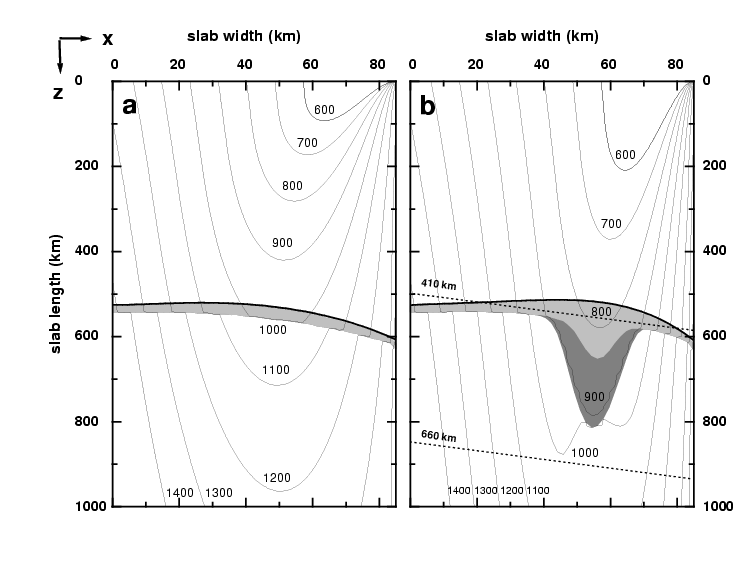 Figure 1
Thermal profiles (in Kelvin) of a slab with a thickness of 85 km
according to McKenzie [16]:
a) vslab = 4 cm/yr, b) vslab = 10 cm/yr.
The metastability region of olivine (grey) and the region
with mixed olivine-spinel aggregates (dark grey) are shown.
|
Next: Grain-size evolution in a subducting slab
Up: No Title
Previous: Introduction
Michael Riedel
1999-01-27