


Next: Acknowledgements
Up: No Title
Previous: Grain-size evolution in a subducting slab
The present results provide also some
insight into the possible mechanisms of deep earthquakes.
Deep earthquakes are believed to occur as a result of instability of
deformation in the ductile regime, and it
has been argued that deep earthquake activities are related to the
transformation of metastable olivine to modified or spinel phase
[1,23].
The nature of instabilities associated with the olivine-spinel transformation
appears to be fundamentally different between the warm and cold branches
of the kinetic phase boundary (branches ``A'' and ``B'' shown in Fig. 2).
Our results suggest that instabilities will occur only when the transformation
occurs in the cold branch ``B''. The effects of grain-size reduction to cause
softening and hence instability will be important only in the
cold branch because significant grain-size reduction occurs only at relatively
low temperatures.
Checking the applicability of the ``standard'' thermal assimilation model
[22,24]
for the occurence of deep earthquakes with seismological observation,
Kirby [25]
found that variations of maximum intraslab earthquake depths
with slab thermal maturity (the thermal parameter) are too complex for
the description with this simple model.
Instead, he and other authors argued (see e.g. Bebout et al.,
[26]) that the
metastable persistence of olivine may cause a nonlinear declination of
deep earthquakes depths in dependence of the thermal parameter.
Here, we partly confirm this hypothesis by
plotting the location of the metastable olivine wedge in the coldest part
of subducted slabs vs. the thermal parameter, Fig. 4.
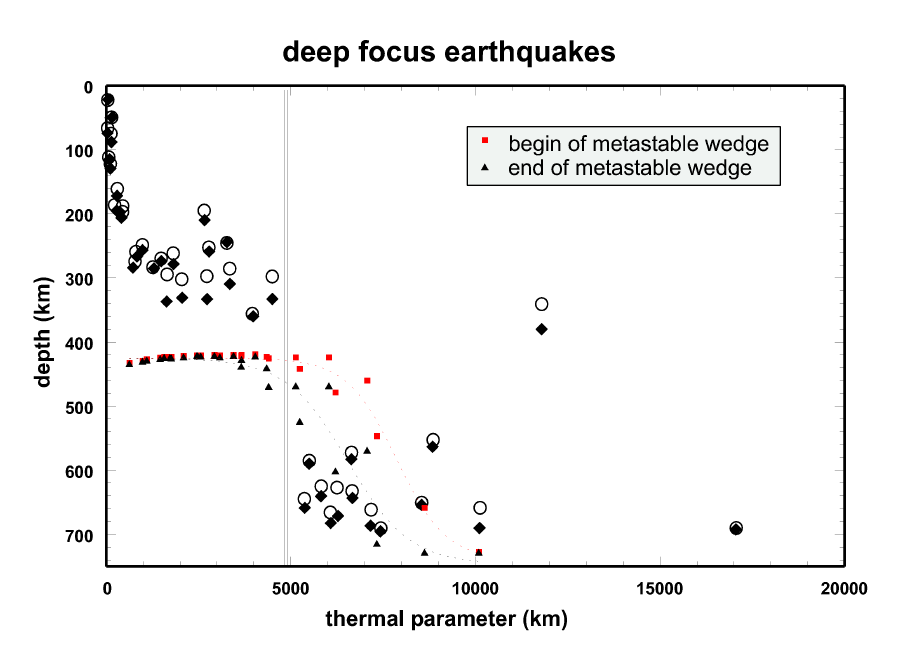
Figure 4
Depth of metastable wedge vs. slab thermal maturity for different
slab thicknesses (60-100 km) and different slab velocities (4, 7, and 10 cm/yr).
Also shown is the compiled data by Kirby [25]
of maximum (diamonds) and next maximum (circles) intraslab
earthquake depths. Note the reasonably good correlation of both plots.
|
Since there are
still large uncertainties in the kinetic parameters underlying the
thermo-kinetic model, the quantitative details of the size and location of the
metastable olivine wedge should be taken with caution.
Despite of this, there seems to be a quite reasonable correlation
of the geometry of the metastability region with the depth of the
deepest earthquakes in several subduction zones.
Next: Acknowledgements
Up: No Title
Previous: Grain-size evolution in a subducting slab
Michael Riedel
1999-01-27