


 ,
grain size after
completion of the transformation), or in 2D (
,
grain size after
completion of the transformation), or in 2D (
 ,
grain diameter at the formation of continuous films).
These scaling parameters are defined as (Y - growth rate; IV, IB -
homogeneous resp. grain-boundary nucleation rate)
,
grain diameter at the formation of continuous films).
These scaling parameters are defined as (Y - growth rate; IV, IB -
homogeneous resp. grain-boundary nucleation rate)
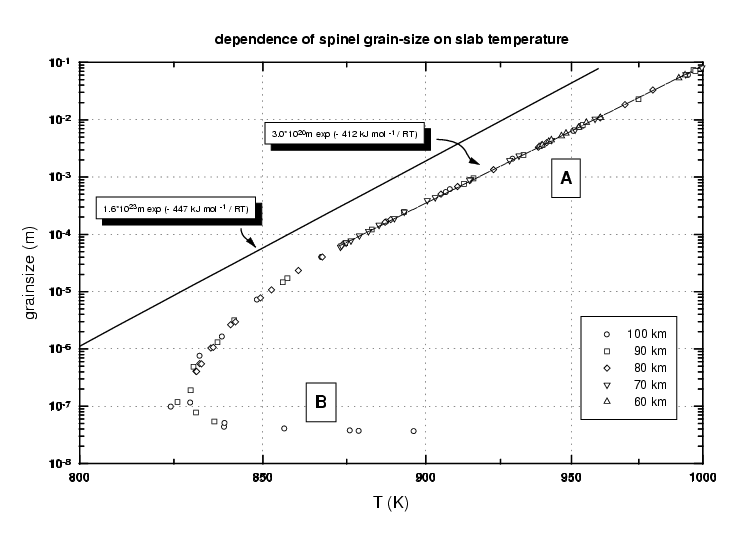
In Fig. 2, we have plotted the numerically calculated spinel grain-sizes according to eq. (1) for a slab with varying thickness (60-100 km) on the basis of the thermal model shown in Fig.1. This plot indicates that under subduction zone conditions a dramatic grain-size reduction up to 4 orders in magnitude is possible when slab temperatures reach values well below 900 K, as a result of the metastable persistence of olivine in peridotite.
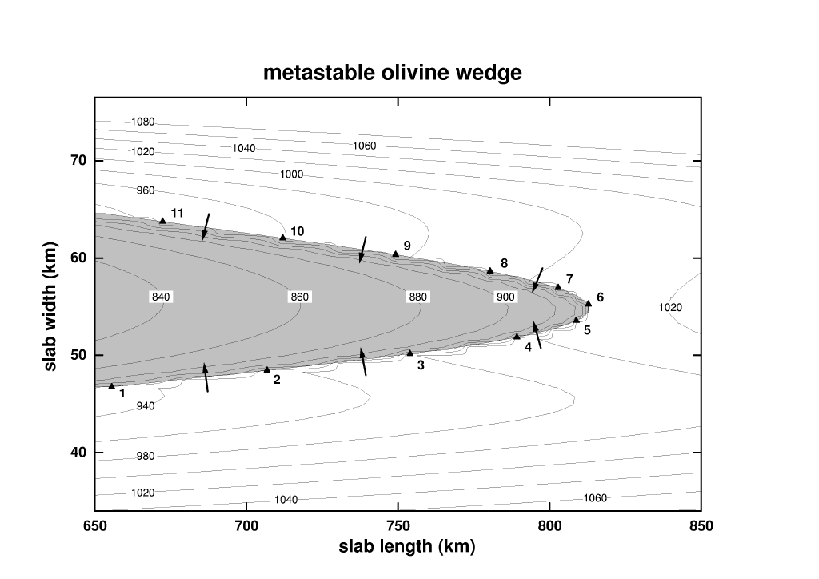
Upon completion of the olivine-spinel transformation, spinel grain-size will be further controlled by grain-growth. The grain-growth kinetics is also very temperature sensitive: it is slow at low temperatures. Therefore, when a phase transformation occurs in a cold slab, any significant grain-size reduction will be kept for a relatively long time. Thus the cold slab interior will tend to have a weaker strength when a phase transformation affect its rheology through grain-size reduction. In Fig. 3, we illustrate the two main effects of the phase transformation, the thermal feedback due to the release of latent heat [17] and the kinetic grain-size reduction, for the case of a slab of 85 km thickness shown in Fig. 1b.
| 1 | 2 | 3 | 4 | 5 | 6 | 7 | 8 | 9 | 10 | 11 |
| 5.01 | 2.76 | 0.43 | 0.23 | 0.10 | 0.08 | 0.07 | 0.08 | 0.12 | 0.19 | 0.68 |
The formation of a continuous film of very fine-grained (sub-micron) spinel
around the olivine grains in peridodite is very likely - at a certain stage of
the transformation (critical volume fraction of spinel
 1% to 10%, depending on
the p,T
-conditions in the slab) - related to a change of the
creep mechanism of the whole slab material. The dominant deformation mechanism
of the cold slab core will then
change from dislocation creep to diffusion creep,
and deformation will occur predominantly at shear zones
along the olivine grain boundaries, resulting
in considerable rheological weakening of the slab interior of fast
subducting slabs.
Both the degree of weakening due to grain-size reduction and the extent to
which the weakened state lasts depend critically on slab temperatures.
Based on the well-known deformation laws for olivine [18,19] and
available data on spinel creep [5], we have estimated
the resulting strength profile of slabs [20].
Taking into account the two
combined effects of latent heat release and grain-size reduction, we found
that
1% to 10%, depending on
the p,T
-conditions in the slab) - related to a change of the
creep mechanism of the whole slab material. The dominant deformation mechanism
of the cold slab core will then
change from dislocation creep to diffusion creep,
and deformation will occur predominantly at shear zones
along the olivine grain boundaries, resulting
in considerable rheological weakening of the slab interior of fast
subducting slabs.
Both the degree of weakening due to grain-size reduction and the extent to
which the weakened state lasts depend critically on slab temperatures.
Based on the well-known deformation laws for olivine [18,19] and
available data on spinel creep [5], we have estimated
the resulting strength profile of slabs [20].
Taking into account the two
combined effects of latent heat release and grain-size reduction, we found
that
Both observations contradict to the conventional picture of cold slabs that they should be mechanically stronger than their surroundings [21,22]. The results cast some doubts on the capability of cold slabs to sustain and transmit higher stresses to greater depth.
![\begin{displaymath}\delta_{Av} = \bigl[I^V / Y\bigr]^{-1/4} , \quad \quad
\delta_{Av}^{2D} = \bigl[I^B / Y\bigr]^{-1/3} .
\end{displaymath}](images/img9.gif)
 m) at the triangle points of Fig. 3