


As a consequence of the inner geometry of the cell, the temperature
gradients over a sample sandwiched between the anvils
remain negligibly small. This was
checked by heating homogeneous discs of metals with a low melting point.
This reveals no
significant spatial dependency of melting onset under visual detection up
to
 C and atmospheric pressure (melt transitions of Sn, Bi
and Pb at
C and atmospheric pressure (melt transitions of Sn, Bi
and Pb at
 C,
C,
 C and
C and
 C,
respectively).
C,
respectively).
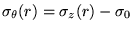
Under uniaxial loading, the stresses generated between the two Bridgman anvils obey the general relationship

with the radial stress  ,
tangential stress
,
tangential stress
 ,
and axial stress component
,
and axial stress component  depending on radius r.
h is the thickness of the sample disc
and f is the coefficient of friction between the sapphire anvil and the
sample surfaces [7].
Its solution for a cylinder with radius R under the external loading
force F is given either by
depending on radius r.
h is the thickness of the sample disc
and f is the coefficient of friction between the sapphire anvil and the
sample surfaces [7].
Its solution for a cylinder with radius R under the external loading
force F is given either by
 |
= | 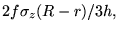 |
for completely elastic deformations, or alternatively by
|
= |  |
for a cylinder deformed in the fully plastic regime, where  is
the yield stress according to the Tresca yield criterion [7].
The radial pressure distribution inside the sample chamber is given by
is
the yield stress according to the Tresca yield criterion [7].
The radial pressure distribution inside the sample chamber is given by
![\begin{displaymath}p(r) = \frac{1}{3} \, [\sigma_r(r) + \sigma_{\theta}(r) + \sigma_z ]
\eqno(5)
\end{displaymath}](img17.gif)
and is either independent on radius r in the elastic limit according to eq. (3), or decreases exponentially with r in the flow region, in dependence of the friction coefficient f and the aspect ratio R/h, as shown in eq. (4).
It can be shown, that, for uniaxial loading, the central part of a sample between rigid cylindrical anvils remains at nearly hydrostatic conditions, separated from a surrounding ring showing plastic flow [8]. In this sense, the outer plastic ring of the sample acts as a gasket for its inner parts.
In addition to uniaxial loading, we are able to apply independent shear forces by rotating the lower anvil. The shear stresses produced in the sample disc are, under boundary conditions of no-slip, a linearly increasing function of rin the central (nearly elastic) region. The total shear stress experienced by the sample is therefore gradually increasing from zero at the centre and reaches its maximum near to yield stress at the periphery ring. The displacement field at the surface of the sample may be reconstructed either by image processing (subtraction of subsequent digitized images), or by means of strain markers distributed over the sample. In both cases, the accuracy is mainly limited by the spatial resolution of the digitizing device (video camera or scanner).