


The cell body was designed for the study of high pressure phase transitions under shear deformation up to 100 GPa confining pressure at ambient temperatures and is described in detail in the literature [4]. In short, it consists of a lever-arm pressure loading mechanism pressing two opposing anvils together, where the lower anvil can be rotated using a suitable external lever rod, see Figure 1. With diamond anvils, the setup was succesfully used to determine the equilibrium phase boundary of a range of solid-solid phase transitions at low or room temperatures [5].
For present purposes, the inner part of the cell consisting of the two anvils
combined with a resistance heating, was completely re-designed:
Instead of diamonds with tungsten carbide support, we use temperature
resistive garnet single crystals machined to small cylinders of 5 mm in
diameter and with a spherical upper surface to build the anvils.
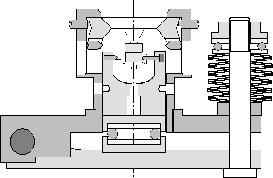
A small compression face up to 2.5 mm in diameter is formed by creating a polished face on top of the upper surface. The smaller the diameter dcf of the compression face, the more effectively it is supported by the mass around it. The back side of the anvils is a plane circle with slightly bevelled edges. The maximum pressure that can be reached in the central part of the sample is given with [3, 6]
![\begin{displaymath}p_{max} (\hbox{in GPa}) = \frac {12.5}{[ \, d_{cf} (\hbox{in mm}) ]^2} \quad .
\eqno(1)
\end{displaymath}](img3.gif)
We estimate that a pressure of up to 2 GPa can be reached
for
 mm.
Using garnet anvils with smaller upper face (0.5 mm diameter), we were
able to reach 6.0 GPa at room temperature without any problems.
mm.
Using garnet anvils with smaller upper face (0.5 mm diameter), we were
able to reach 6.0 GPa at room temperature without any problems.
Commercially available mantled heater wires (0.5 mm in diameter) wound around the anvils deliver heat mainly by direct thermal conduction. This geometry requires the least input of power and the lowest heater temperature in order to achieve a desired sample temperature [1]. The parallel alignment of both garnet anvils must be guarantied in order to prevent their destruction during shearing under an external axial load. Under applied torque during the deformation experiments, the cubic symmetry of the garnet anvils is slightly disturbed, and a weak cross shadow appears under crossed nicols superimposed to the sample image. Taking a time series of digitized snapshot images, it is possible to compensate this effect using suitable numerical routines.